

Beyond the Certificate: Why Judgment Is the Real License to Operate
by Bruce G. Kreeger
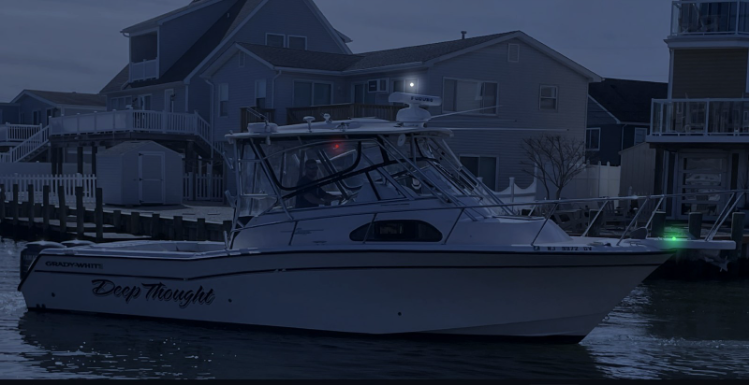
Deep Thought underway at night, running lights on.
Taking the NJSP Boating Safety class and earning your certificate is only the beginning. Certification tells you the rules — experience and judgment tell you when to apply them.
That distinction matters more than most new boaters realize. A certificate is proof you can answer questions correctly on a test. It says nothing about whether you can read a building chop, hold a course in fog, or thread a crowded channel on a July weekend. The water doesn’t check your paperwork before it decides how it’s going to behave.
Operate to Your Skill Level, Not Your License Level
Day or night, the standard that matters is what you can actually handle — not what your card says you’re allowed to do.
Know your limits. A certificate proves you passed a test, not that you can handle chop, fog, or a crowded channel. Build experience gradually before pushing into tougher conditions. Every experienced operator started as a nervous new boater who kept trips short, stayed close to shore, and added difficulty a little at a time. There’s no shortcut that replaces those hours on the water.
Slow down after dark. Reduced visibility means less reaction time — for you and for boaters around you. Running lights help others see you; they don’t replace a proper lookout. Lights tell other vessels where you are. They do nothing to tell you what’s in front of you — a piling, a swimmer, a paddleboarder without lights of their own. That’s still your job, and it’s harder at night no matter how well-lit your boat is.
Match speed to conditions, not just posted limits. Visibility, traffic density, wake, and your own comfort level all matter. A speed that’s perfectly legal in open, calm water can be reckless in a crowded inlet at dusk. The posted limit is a ceiling, not a target.
Reassess constantly. Weather, fatigue, and unfamiliar water all erode the skill you’re operating with in real time, even if your certificate doesn’t change. The operator who was sharp at 9 a.m. after coffee and a full night’s sleep is not the same operator who’s been fighting a headwind for six hours. Conditions change. So do you. Keep checking both.
The One Rule With No Exceptions
Never drink and operate a boat. Alcohol impairs judgment, reaction time, and balance faster on water than on land — BUI carries the same penalties as DUI, and the risks are just as deadly. Sun, motion, wind, and dehydration all compound alcohol’s effects on the water in ways they don’t on a highway. This isn’t a judgment call to weigh against the others. It’s a line that doesn’t move.
When in Doubt, Throttle Back
A slower, cautious operator is a safer one — for their passengers and everyone else on the water. Throttling back costs you a few minutes. Pushing through when you’re unsure costs a lot more, and not always to you — everyone sharing that water pays the price of someone else’s overconfidence.
The Bottom Line
The certificate legally gets you on the water. Judgment keeps you — and everyone around you — safe on it. Treat the class as the floor, not the ceiling, and keep building the experience that no test can hand you.
